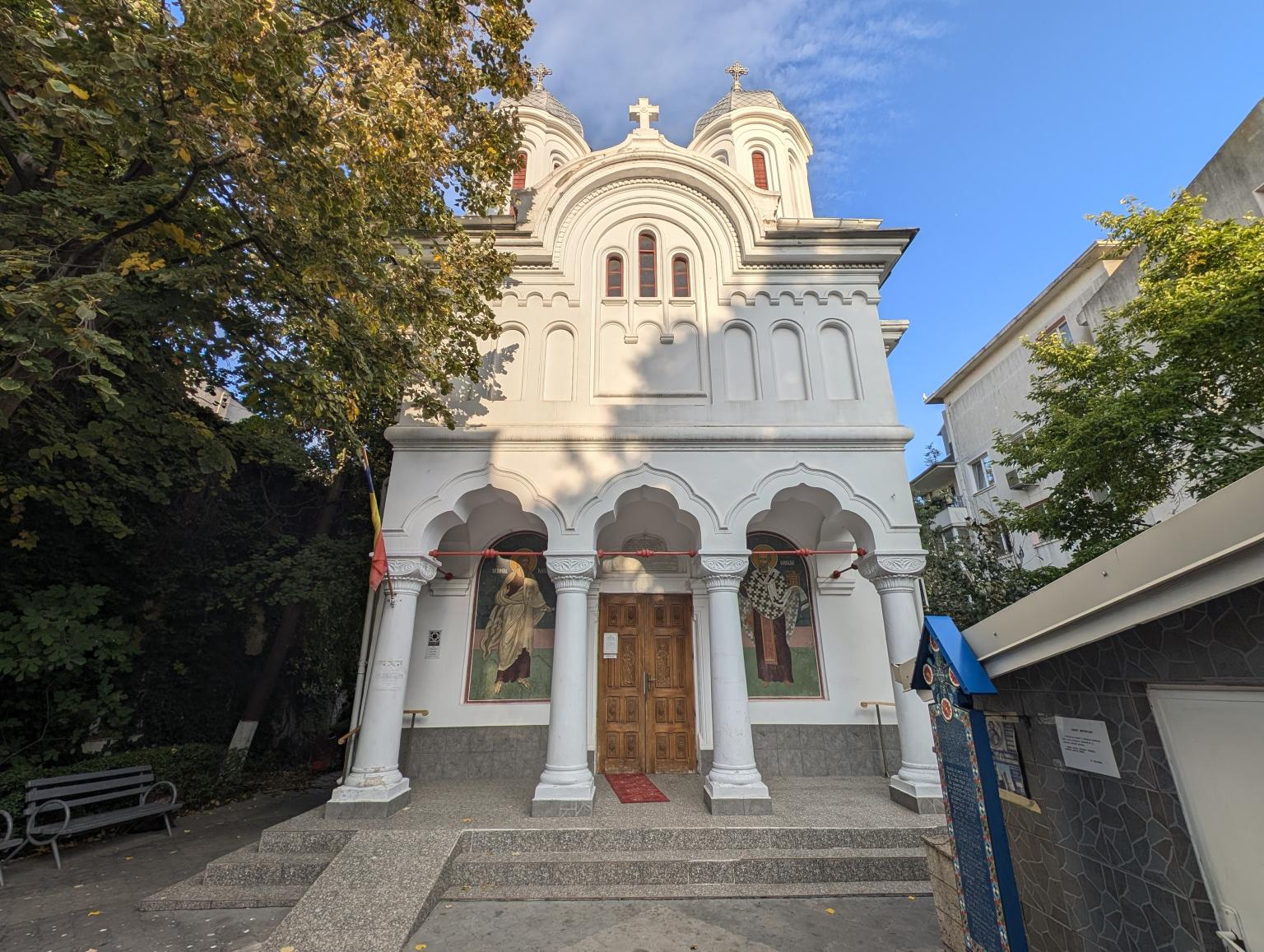
The place of worship was built between 1898 and 1907. It is located in the historic center of Constanța, on Maior Gheorghe Șonțu Street, at number 7. The church preserves the specific features of Romanian architecture, being decorated with Cyrillic inscriptions and fresco paintings. The painting was done by Ioanid Bătrânul, Mihail Fordea and Florin Vlad, all from Bucharest. The Bulgarian community in Constanța made sustained and long-term efforts to build a church in the old Bulgarian quarter of the city. The initiative belonged to the community leader, Ivanciu Hagi Stoian, who convinced the wealthier members of the community, as well as others, to purchase a plot of land in the neighborhood, where until then they had been using a former warehouse as a place of prayer.
From here, the approaches to the Constanta City Hall, which had no objections, and to the Ministry of Religious Affairs, headed at the time by Take Ionescu, began. The latter declared his support, but mentioned in 1895 that the necessary approvals must be obtained from the Diocese of the Lower Danube, headquartered in Galați. Delegations were sent to Bucharest, Sofia, where they met with deputies and even Prince Ferdinand, and the plans even included a request for support from the Russian Tsar, Nicholas II. Their sustained efforts materialized in October 1898, when the then mayor of Constanta, Eugen Schina, issued the construction permit for the Bulgarian church, dedicated to "Saint Nicholas", on Maior Gheorghe Șonțu Street.
The construction work took place over a period of almost ten years, and in 1907 the church was consecrated. Over time, the church went through different periods. During the Bulgarian occupation of World War I, between 1916 and 1918, the church was spared from looting and destruction, while such acts had become frequent around it. Later, the Treaty of Craiova, signed on September 7, 1940 between Romania and Bulgaria, which regulated the fate of the counties of Durostor and Caliacra, also provided for population exchanges. Following this agreement, the Bulgarian community in Constanța left the city.
The Bulgarian church was then left without parishioners. The following year, 1941, during the Soviet bombings, the Episcopal Cathedral in Constanța was damaged, and the small church "Saint Nicholas" became, for a period of several years, the city's cathedral. The same place was also used for a quarter of a century, between 1961 and 1987, as a spiritual refuge and place of prayer by a small group of Lutheran Germans from Dobruja. During that period, Orthodox services were held only on the occasion of the patron saint's day on December 6. It was not until 1987 that the church was returned to the Orthodox community of Constanța.
Sursa: heritageconstanta.com