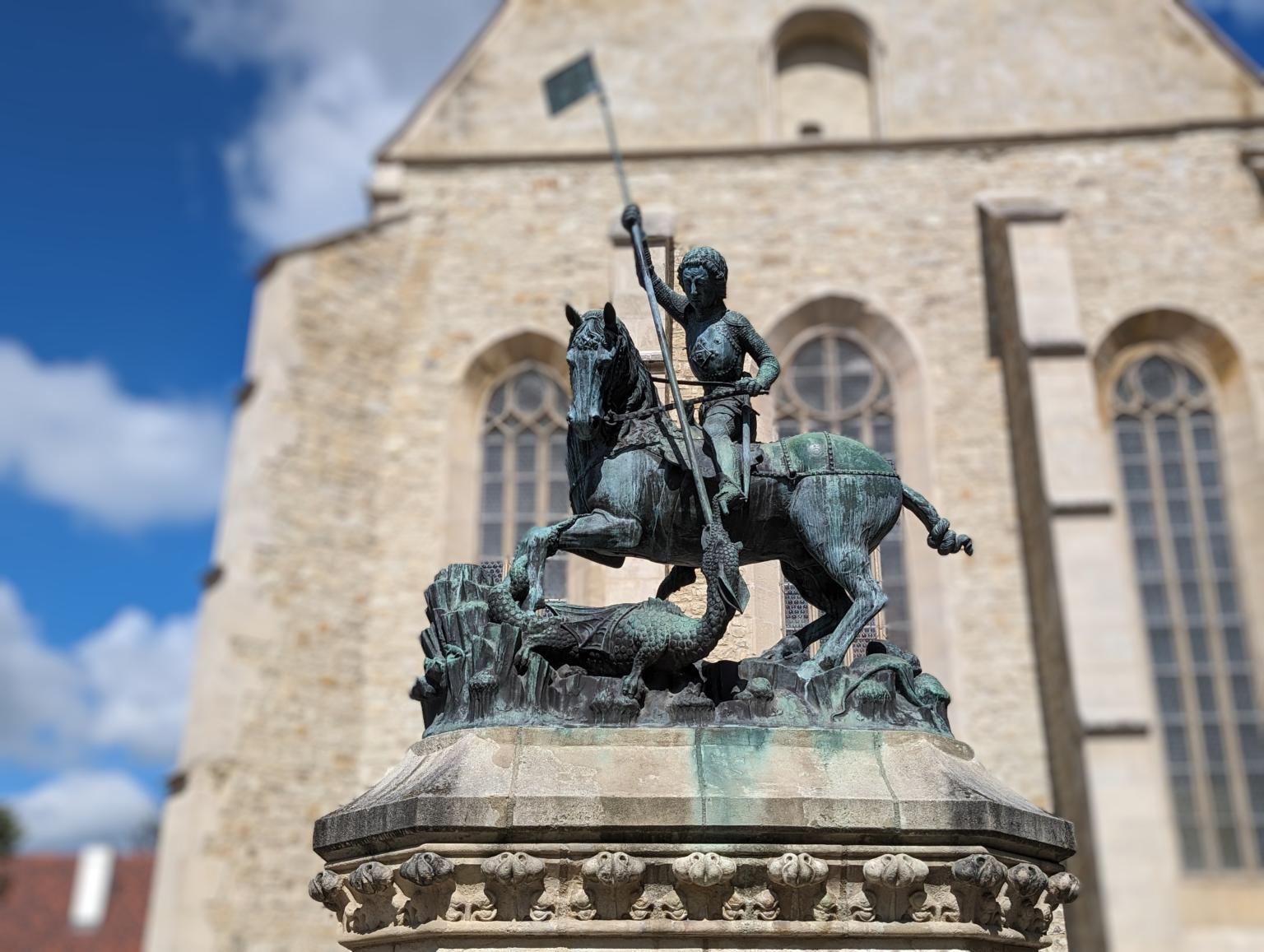
The equestrian statue of Saint George slaying the dragon, placed in front of the reformed church, is a bronze replica of a famous statue made in 1373, present in the courtyard of Hradcani Palace in Prague. Commissioned by King Charles IV of the Czech Republic, the original was created by Cluj sculptors Martin and Gheorghe, sons of the painter Nicolae Glussemmberch.
Their creation represents a high point in the evolution of Gothic art from the end of the 16th century and is among the most valuable works of the time in a European context, thanks to their precocious vision and bold interpretation.
The work is distinguished by the proportionality of the component elements, where the man, the horse and the dragon are integrated in a logical and uniform structure, also highlighted by the impeccable plastic treatment.
The horse, captured in an expressive rearing movement, outlines a strong silhouette in space, and its attitude, which reflects a deep understanding of equine anatomy, stylistically surpasses all equestrian statues of the European Gothic and can compete with the first equestrian sculptures of the early renaissance of Europe.
Its model, probably inspired by the famous equestrian monument of Marcus Aurelius in Rome, can be identified in the art of ancient sculpture.
The rider and dragon, as well as the plinth of the statue, are part of the Gothic tradition. Despite the massive appearance of the armor, the rider's body appears stiff, and the intensity of his gesture of thrusting the spear into the dragon is not clearly emphasized enough. The plinth, decorated with dwarf shrubs and aquatic animals such as lizard and snake, stands out for its analytical approach and picturesque stylization.
Originally placed in the Lucian Blaga square, the statue was moved to its current location during the systematization of the area.
These creations of Transylvanian sculptors had a significant impact in the larger context of European sculpture of the 16th century. Martin and Gheorghe are believed to have started their careers in a silversmith's workshop in Cluj, then had contact with the cultural center in Oradea, with cultural links to Italy and the papal citadel of Avignon. This road took them to Rome, where they were exposed to Italian and Avignonese art. They later traveled to Flanders where they perfected the arts of bronze casting.
Among the creations of the two Cluj artists are the bronze statues of the Arpadian kings, as well as the equestrian statue of King Ladislaus, originally placed in front of the cathedral in Oradea, later captured by the Turks and taken to Belgrade, being melted down in 1660.
Source: City of Cluj-Napoca and surroundings (Ministry of Tourism, 1982)